Not having to do the dishes...
food
chocolate brioche
...and having a chocolate brioche for breakfast. Thanks to Alice.
Not having to do the dishes...

food

chocolate brioche
...and having a chocolate brioche for breakfast. Thanks to Alice.
At home I have put many beans through the grinder, into the stovetop and drunk usually as a long black with flat milk (I am drinking one as I write this). I have had several bean favourites but these were blown away when I tried the Italia blend from Tony Gibbs recently.

Gibbston Coffee Interior
Although his tiny café on the Terrace has been operating since 2001 it has been unnoticed up until now. Maybe this is because the sign overhead remains blank and the café doesn't even have a name.
The lack of a sign was no hindrance to the flow of people coming in and out of the cafe while I was photographing, most of them exchanging greetings with Gibbs while he roasted beans. The beans are roasted in a fully restored Aug Olsen originating in Denmark.

Gibbston Coffee

Gibbston Coffee

Gibbston Coffee
Gibbs has been roasting beans since 1987 when he was trained by George Kepper, an Australian based Russian who consulted several of the big roast companies in Sydney from time to time to correct blends and adjust roasts that were not quite right. The Italia blend was perfected by Gibbs on visits to Kepper in Sydney and has not been altered since 1987.
Of the beans Gibbs purchases for his café he rates the Columbian Medellin Supremo as the best (and the most expensive), supplied by John Burton, New Zealand’s primary importer of beans for smaller roasters.

Gibbston Coffee

Gibbston Coffee
Gibbs’s blends, aside from the Italia include TG Pearl, Indian Mysore (named after the Southern Indian province where it comes from) and Brazilian which is made especially for the drinkers at Taste Café in Kelburn, one of two cafes Gibbs supplies (the other is Salvation in Newtown).

Gibbston Coffee

Gibbston Coffee

Gibbston Coffee

Gibbston Coffee
Located in Wellington’s corporate heartland (the PM drops in for coffee and the Treasury is right opposite) it is great to see someone putting taste firmly on the bottom line.
Stop Press: The cafe has been renamed Old George (after the Russian who taught Tony Gibbs how to roast the beans) and is still producing the best coffee in Wellington

Old George coffee beans with new packaging in Wellington.
“Please bring organic olive oil and flour if possible…” Having booked numerous accommodation suppliers over the years, I was impressed by this unique approach from Swasti Eco Cottages in Bali. After leaving Common Sense Organics with the Bali bound bottle of Moutere Grove Organic Olive Oil I looked forward to handing it over to the Swasti kitchen once we got to Ubud.
Arriving at Swasti we quickly made a tour of the organic garden. The range of produce included turmeric, mulberries, egg plants, tomatoes and some Avatar lookalike goats.
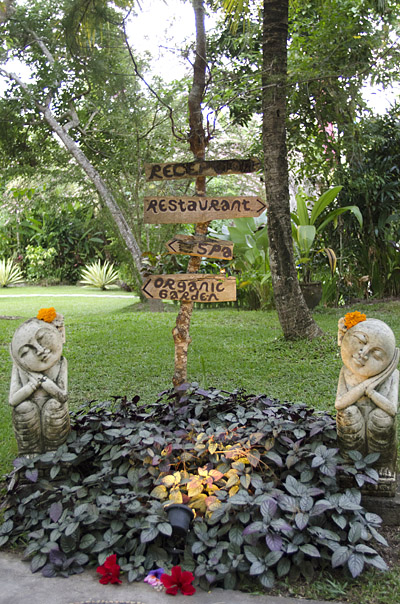
Entrance to Swasti Eco Cottages in Ubud, Bali
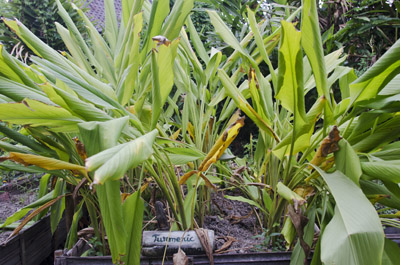
Organic tumeric at Swasti Eco Cottages in Ubud, Bali

Organic Anglo-Nubian dairy goat at Swasti Eco Cottages in Bali
After a couple of days exploring the wonderful Ubud surrounds I finally got to photograph Pa Putra (one of the Swasti kitchen staff) holding the Moutere Grove oil in the dining room. In return for the organic oil we received two free desserts.

Pa Putra from Swasti Eco Cottages holding Moutere organic olive oil from New Zealand
Other highlights were the squirrels darting around the treetops, the frangipani flowers draped around our room, frogs croaking through the night, very friendly staff and the abundance of fresh produce on which we dined.

Interior of Rama Room at Swasti Eco Cottage in Ubud, Bali

Breakfast at Swasti Eco Cottages in Ubud,Bali
However it will have to be the next visit for the 3 in 1 chocolate massage, black rice icecream or a special drink of organic raw cacao, banana and cashew milk.

Special drinks blackboard at Swasti Eco Cottages in Ubud, Bali
Although it was left behind the Moutere Grove Organic olive oil will feel right at home.
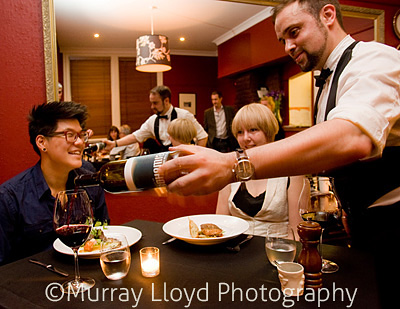
Waiter pouring wine in restaurant
Ambeli Restaurant rated highly in the restaurant scene in Wellington ( it has now closed) and I was hoping to translate this standard into a photograph for the Entertainment Book.
Wanting the mirror reflection in the image, Shaebodine Moleta (Ambeli’s owner) showed no hesitation when asked to ‘adjust' the table’s height to achieve this. I was impressed. The image was meant to show just the couple enjoying themselves but this photo (the test exposure) ended up with Moleta perfectly placed pouring wine. I love being able to capture a documentary image from what was meant to be a posed setting.
Traditional Scarecrow

Pinot plungers at Scarecrow Festival in Greytown

Scarecrow looking like a Chef with barbeque and sausages at Scarecrow Festival in Greytown

Gueorgui Pinkassov photo on Slow magazine cover
Slow, the food magazine published by the Slow Food Movement from 1998 through to 2007 is the most fabulous magazine I have ever laid my hands on.
It has a most tactile feel (pages are Bioprima Book Paper), the covers (Fabria card from the Miliani Fabriano Mills) are beautifully designed and the use of photography is extraordinary.

Ferdinando Scianna photo on cover of Slow magazine
It is the only time I have seen elephant hunting in colour paired up with black and white photographs of breast-feeding mothers. To top that off the magazine is full of Magnum photography from practitioners as diverse as Henri Cartier Bresson, Chris Steel Perkins and Gueorgui Pinkhassov. If you can track a copy down great – I have been lucky to have loaned a few copies from a friend.
The Elephant hunting story is illustrated with photos by Magnum photographers Martine Franck, Dennis Stock and also by Eugene Richards a past member of Magnum. Issue No. 46 has a funny photograph by Magnum photographer Chein Chi Chang and another amusing photo by Ferdinando Scianna of a bar scene in Miami, Florida. On a more sombre note issue No. 50 has a striking image taken at the Tokyo Fish Market by Bruno Barbey.
The magazine may have ceased but at least the Slow Food Movement is still going.
The inedible food at the Mad Hatter’s Tea Party seemed very un-birthday partyish but after being served free tea and Kiwiana themed biscuits the mood became more festive. Although surrounded by tea cosies rather than mad hats this exhibition at the Kapiti Art Gallery resonated well with events on the other side of the world.

Asparagus rolls and crackers at Mad Hatter's tea party in New Zealand

Wool crackers at Mad Hatter's tea party in New Zealand

Crackers at Mad Hatter's tea party in New Zealand

Wool sandwiches at Mad Hatter tea party in New Zealand

Kiwiana biscuit in shape of Kiwi

Kiwiana biscuit in shape of New Zealand

Wool food at mad hatters tea party in New Zealand

Wool food at mad hatters tea party in New Zealand
The can of whale meat pulled from sale on Trade Me recently (thanks to Project Jonah) reminded me of a can rusting away in our house. This can arrived in New Zealand in 1989 originating from North Korea . It was brought into the country by a couple of young adventurers returning from a trip sponsored by New Zealand’s communist community. In 1989 the law in New Zealand stated you could not import any raw whale products so I guess the customs officials turned a blind eye to the cooked contents from North Korea. Changed in 1999, the law now prohibits the import of all whale products including the contents of this can.
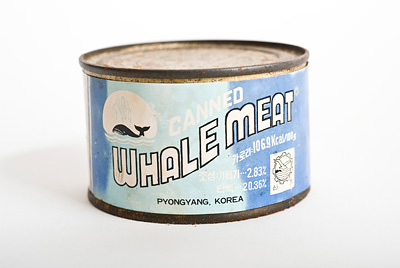
Whale meat

Whale meat

Whale meat
If you want to get your hands on the real Scream you will have to spend more than 140 Million NZ Dollars, its last sale price. So here’s to the imperfections of the world, home grown produce, and heritage crops which can be very satisfying at a fraction of the cost.

The Scream

The ghost

The Taniwha

Mischief

The home of Northland pineapple
Expect the unexpected is what the tourists are told when coming to New Zealand and that is just what I got when visiting my brother in the Far North this summer. The talk had turned to a couple growing pineapple just a couple of kilometres down their dusty inland road.
With a quick phone call and a short drive, I was shown around the home of Jan Tagart and Steve Cottis, and close to one thousand pineapple plants.

Jan Tagart and Steve Cottis

New Zealand pineapple

New Zealand pineapple

New Zealand pineapple
After spending a sweltering hour and a half in two large tunnel houses photographing Jan, Steve, plants and the pineapple I was invited to taste a piece of the exotic fruit.
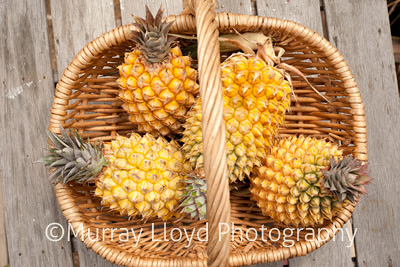
New Zealand pineapple

New Zealand pineapple
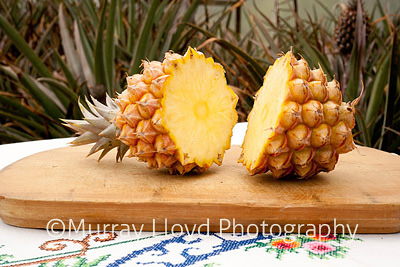
New Zealand pineapple

New Zealand pineapple
As the tropical flavours enveloped my taste buds I realised I had never really tasted pineapple before. The underwhelming supermarket supply in New Zealand had put me off what was a taste sensation.
Sold only at the Bay of Islands Farmers Market in Kerikeri at prices between five and twelve dollars the Tagert and Cottis stand gets plenty of repeat customers including one who was reminded of “pineapple grown in the Islands”.
It all started with two plants given to Jan by her chiropractor in Mangonui (home of the famous fish and chip shop) and another nine from a greenhouse in Kerikeri. Jan and Steve now have enough plants to supply their local market with fruit most of the year.
Back in Wellington Pina colada will never be the same.
The calf having lost its mother was put into a paddock with Spook the horse. The orphaned calf does get hand-fed but clearly feels the need for more. And Spook is happy to oblige.

Hand feeding orphaned calf

Hand feeding orphaned calf

Horse feeding orphaned calf

Horse feeding calf
Following my blog in July celebrating the best ham we and our guests have ever eaten it was a pleasure last week to visit Canterbury’s Murellen Pork, birth place of the 21st Birthday ham.
Expecting the high pitched squeal of pigs on arrival I was surprised not to hear a peep from the grunters. Located in the lee of Mount Torlesse just out of Sheffield, this resplendent piggery sits on 20 acres of mostly glossy green grass.
Murrellen Pork was set up in 1999 by Murray and Helen Battersby (hence the name - Murr-ellen). After farming pigs in the area for 40 years the couple realised to upsize the operation they could either focus on quantity or quality – and chose the latter. Now managed by son Colin and wife Karen, Murrellen Pork farms around 1500 pigs at any one time. Colin says this number means they can keep the ‘owner operator’ feel of the business.
Like a Wellington team management text, the farming practice is built around reducing stress. Some techniques follow the research of Temple Grandin, famous for her extraordinary knowledge of animal behavior. The entire supply line has been analysed and set up to avoid stressing the animals unnecessarily. For example the pigs are trucked to Timaru for processing via State Highway 50, instead of State Highway 1. This is not for the scenery but because the truck only needs to stop twice on the way. Every stop on a journey arouses the pigs and they get stressed! On the farm round feeders are used instead of straight designs. Pigs have narrow vision and being able to keep an eye on the pigs on each side while eating allows for a more relaxed mealtime and improves nutrition intake. Other measures include PH analysis of the meat and temperature control of the pig enclosures..
While being fattened up at the Murrellen premises the pigs are initially housed in mobile pens (the piglets arrive from a free range supplier) before shifting to a larger facility for the final five weeks. In a similar manner to Joel Salatin mobile chook houses (as described in the book the Omnivores Dilemma these pens are regularly dragged onto a fresh patch of grass with the resulting rich effluent spread to fertilise new grass and enormous worm farms. The pigs are fed a locally produced vegetarian diet which supports the mobile self-fertilising system.

Pigs in pen in New Zealand


The effect of the Canterbury earthquakes on Murrellen has been twofold. Restaurant closures in Christchurch meant a substantial drop off in demand and Murrellen’s office, and the historic house where Colin and Karen live will probably be demolished.
If you are after New Zealand pork, charcuterie or other piggy offcuts, Murrellen’s produce can be sourced via discerning Christchurch and Wellington butchers. They include Ashby’s in Christchurch which won the best bacon award in 2011 with Ashby’s Murrellen dry cured bacon, and Waikanae Butchery who was the Gold Medal Winner (Pork category) in The Great New Zealand Sausage Competition 2009.
Fresh from opening Depot - his Auckland restaurant, Al Brown arrived at Ruth Pretty’s garden room to promote his new book Stroked.

Al Browns book Stoked, at Ruth Pretty garden room
In front of a small gathering in his trademark laid back style Brown talked about his backyard, his TV show, and more.

Al Brown and Ruth Pretty

Al Brown talking about his new book Stoked
As guests ate their way through tasty morsels including chargrilled tuatuas (actually it was a gas barbeque), smoked kahawai potato cakes and marshmellow caramel muesli slice, Brown explained his philosophy on food.

Barbecued Tuatuas
It’s about savouring the journey to the plate; the prep, slowing down and enjoying. “By the time food arrives on a plate its dead”. Fitting with this philosophy Stoked is about cooking on an open fire (preferably your own hunter-gathered produce). A stark contrast he says to books of recipes containing only four ingredients, ten minute meals, and frozen sushi.

Pulled pork sandwiches with apple coleslaw

Al Brown talking at Ruth Pretty's Springfield in New Zealand.
As Brown munched on a pulled pork sandwich (with apple cider slaw) he described his own backyard on the South Coast of Wellington; the big outdoor fire, a wood-fired oven, a chargrill, a Japanese teppanyaki plate and yet another oven that acts as a warmer. A set up Brown says was designed “to take cooking classes for Khandallah housewives if the phone didn’t ring after leaving Logan Brown”.

Al Brown's marshmellow caramel slice
Despite a packed programme Brown has created a winning combination in his new Auckland establishment. Depot seats 70 and is already doing 300-400 meals a day. No dots on plates, formality left at the door and serving wine ‘on tap' are some of the markers of this fresh restaurant. Underlining Brown’s approach to food, Depot’s current menu includes freshly shucked oysters and cockles, wild pork salami, wild rabbit rillettes, kahawai, snapper, kingfish and food cooked over charcoal or hardwood.
Unfortunately for Wellington, a Depot style restaurant will not be arriving anytime soon. Brown says this is partly the due to the capital’s smaller population, but also to his vision of expanding into Australia. The audience left the garden room warm and contented with Stoked. They’ll be lighting their own fires.
Food heros of Welsh culture were spotted amid a sea of green wigs, and floating red dragons at Saturdays RWC game between Wales and the Irish. The leek, an emblem of Wales since the mid 16 th century, is often referred to in relation to St David's day on March 1st, but also has links to Welsh rugby,
Lamb (or were they sheep?) is revered in Wales in a similar way to lamb in New Zealand.
I am not sure what part of Welsh culture the chicken stands for but the guy on the left arrived in New Zealand with not much more than this suit...

Welsh fans in chicken suits at Wales vs Ireland RWC game in Wellington
The dragon got hungry - Wales 22, Ireland 10

What - so the chicken is so full of hormones it sucks up to the mustard?

Natural and organic wherever you look it looks plastic

John Key would be a vanilla trumpet

In the film Jiro Dreams of Sushi the Michelin stared chef bemoans the state of the tuna fisheries
Venison Carpaccio, sirloin steak and lamb pie were all on the menu at Wellington’s city market on Sunday morning. Chef Rex Morgan of Boulcott Bistro presented the "Meat your Maker” class in front of 20 eager participants who paid $50 for the one and a half hour cooking demonstration. Slamming the venison flat with both pot and hammer seemed to alleviate Morgan’s frustration of the early morning wake up due to the introduction of daylight saving.

Rex Morgan
The venison came from Premium Game Meats in Blenheim ( Morgan thinks "the shooter" might have come from near Picton). After stressing how scale is important to food presentation, Morgan married the venison with a red pepper mayonnaise, micro greens, olive oil and parmigiano reggiano.

Rex Morgan at City Market
Next to hit the gleaming Gaggenau bench top was a large slab of beef sirloin.

Rex Morgan at City Market
Looking to Italy for inspiration, Florentine steak was next item on the menu. Marinated with lemon and herbs for three days, the finished steak arrived juicy, flavoursome and with mouth filling texture. The sirloin was supplied by Silver Fern Farms in Hawkes Bay.

Rex Morgan is one of New Zealand’s Beef and Lamb Platinum Ambassadors, and it was appropriate for the next dish to feature New Zealand’s woolly food hero. Watched by the class and numerous unofficial market goers, Morgan combined an Alain Ducasse styled pastry top with a very tasty and colourful lamb, tomato and pea filling.

Handing out the pies

Lamb pies

Sirloin steak

Venison Carpaccio

The pies baked, and guests sipped on the wine of the day, a 2009 Jackson Estate Vintage Widow Pinot Noir from Marlborough while Morgan assembled his knife sharpening kit. Use of oilstone and steel was demonstrated including the useful tip – replace the steel with the bottom of a ceramic bowl if this tool is absent.
The class ended on a poignant note when one of the guests praised Morgan’s recipes for being ideal for one person – her kids had long left home and her husband had passed away recently - soul food indeed.

Fresh picked seville oranges from New Zealand
The scent of Andalucía, described as bitter and lumpy arrived in my studio recently. Hard to source in New Zealand, it was a surprise to find the Seville oranges had originated from an orchard in Whenuapai.
Jennifer and Roy Taylor, who in the past made jams and chutneys under the Forgotten Fruits label, now deal exclusively with 65 Seville orange trees. Regarded as THE marmalade orange (do not eat!), the Seville oranges are named as such because there are thousands of these trees lining the ‘calles’ of this beautiful Spanish city.
Encouraged to make marmalade (for the first time) I hauled out Jane Grigson’s recipe for whole orange marmalade. It all seemed straight forward until I got to the line “boil vigorously for 10 minutes”. Great I thought - it will be done before dinner. Wrong. It was after 10pm before the jars were being filled.
However the dark, flavoursome brew spread on the next morning’s toast made the effort well worthwhile.

Homemade seville orange marmalade on organic toast with organic coffee

Try your luck on Trademe when the oranges are in season around September each year.
Described as the “Jamie Oliver of Malaysian cooking”, Chef Wan was the undoubted star of the inaugural Wellington Malaysia Kitchen Night Market. A household name in Asia , crowds clamoured to hear him speak about and cook traditional Malaysian food. The packed audience included a very excited Lauren King, who was one of the lucky recipients of Chef Wan's demonstration dish Vermicelli Kerabu.

Chef Wan

Customers at the event
Held in one half of the cramped Opera House Lane, the market was the finale of this years Wellington On A Plate. Wan’s excited commentary (see him in action here), broadcast at full volume, contrasted with the slow moving crowds waiting for their fix of Malaysian cuisine.

Malaysia Kitchen Night Market
Working under intense pressure the chefs from Kayu Manis, Rasa, The Long Bar and other Wellington Malaysian restaurants still managed to serve up delicious char grilled satay sticks, curry puffs, rendangs and gorengs ...

Ganesan Duraiswam from Rasa

Rajah Vellasamy from Kayu Manis

Swa Siong from the Long Bar

A happy customer

...the menus however lacked the real diversity I expected of Malaysian street food. This was a probably a reflection on having only a small number of stands to feed the heaving crowds quickly (the event ran for 3 hrs), with easily identified food.
The fundamental aim of Wellington On A Plate is to attract foodie tourists. Air Asia X ‘s arrival to NZ has seen a dramatic increase in Malaysian visitors to NZ (1300 to 5000 monthly in Christchurch) – no doubt coming for the clean green scenery. Likewise, tourism from NZ to Malaysia has increased markedly. I applaud the organisers of the Kitchen Night Market for getting involved with WOAP for the first time, but there is room to put Malaysian street food on a larger stage, with more variety and enthusiastic crowds in the future.
Raw meat, furry tails and live insects were on the menu at a recent Ruth Pretty Catering event. In weather more appropriate for emperor penguins, Wellington Zoo was host to the Ruth Pretty Zoo Safari, part of Wellington on a Plate. Perhaps reluctantly swapping the heated floor of Kamala’s, the swish new zoo venue (named after the zoo's last elephant), the visitors were soon being educated about animal diets in the zoo kitchen.

Possum tails hang out of bucket at Zoo Safari at Wellington on a plate

Ruth Pretty introducing the Zoo Safari as part of Wellington on a plate

Animal food

Young boy looking at zoo food

Goat legs at the Zoo safari
Slabs of horse meat, goat legs - fur and all, and live locusts were all sighted, but most interest centered on chimpanzee food. Paul Horton, the carnivore keeper said “chimps are pretty much like us, they will happily kill a monkey and share it around”, dispelling any thoughts about vegetarian diets. As well as fruit and veges, the chimps are occasionally fed whole chickens, cooked, to avoid salmonella. Bread used to be part of the chimp diet until Jess, a female, took such a liking to it she upsized to become the largest chimp in the tribe – not the normal way of things in the ape world.
Climatic extremes continued on a short tour of the zoo, taking in Happy Feet the emperor penguin, and Sasa and Sean the sun bears. Happy Feet tentatively looked like coming out and diving into the pool (a zoo first), but after dipping a ‘toe’ into the water, turned around, and waddled back inside.

Happy Feet the penguin
In a similar manner the guests made their way back to the warmth of Kamala’s where a South African high tea awaited.

Food prep at the Zoo Safari at Wellington on a plate
The safari themes were continued with the menu including biltong, hertzoggies, and snoek pate and wait, was that…Dr Livingston I presume?

Zoo Safari at Wellington on a plate

Biltong was on the menu

Diners at Ruth Pretty’s Zoo safari

“The world’s first vegan pavlova!” claimed Professor Kent Kirshenbaum, while giving a presentation at Ruth Pretty’s unscheduled WOAP event. He thought he may have also produced New Zealand’s first vegan meringues, but was surprised to find Angel foods (an Auckland-based vegan supplier) had beat him to it. Kirshenbaum, a New Yorker, was in New Zealand to help celebrate the 2011 Year of Chemistry.

Kitchen Chemistry
Luxuriating in the space the commercial kitchen provided, Kirshenbaum and his assistant Anne McBride took us on a world tour of mysterious ingredients. First was the Chilean Quillaja Saponaria- its soapy properties can be used to make extra head on low alcohol beer, fire fighting foam and of course the vegan meringues. The inner bark of this tree has also been linked to methane reduction in dairy cows and lowering of cholesterol in humans.

Kitchen Chemistry
After being served an unusual warm syrupy drink by Ruth Pretty, the Professor introduced us to Salepli Dondurma the Anatolian stretchy ice cream. The stretch ingredient in the ice cream is called salep and is derived from rare Turkish orchids – so rare the Turkish authorities have banned the export of this plant extract. I found out my syrupy drink was made with salep – apparently sourced in Wellington!

Kitchen Chemistry
Not deterred by the unavailability of salep Kirshenbaum and McBride zapped us up a topping for the meringues using versawhip, xanthan gum, sugar and raspberry sauce. Xanthan gum also has links with our dairy industry as it can be derived from whey, the by-product of cheese making. We got to eat the raspberry-topped meringues (recipe is below) – the dessert had good texture but the herbaceous taste of the meringue had me thinking I’ll stick to egg whites.

Kitchen Chemistry
The Professor had clearly done his research on New Zealand, with his next topic being the barbecue. Obsessed with the smoky flavours of the BBQ, but unable to use one at his apartment (“I’d be arrested in New York if I started one”), Kirshenbaum was drawn to analyse liquid smoke. He deduced it is probably safer to use than untreated-wood smoke due to the carcinogens being removed. Could this be the end of this bastion of New Zealand culture?
The perfect steak? The exact time for a fillet of salmon? Precise times for cooking an egg? Try out sous vide cooking (precise temperature control). How about reductions without heat, centrifuges and rotovaps - it all sounds like science fiction but science in the kitchen is already nearby - think Martin Bosley, Ferren Adria, and Hesten Blumenthal. For more about molecular gastronomy check the Experimental kitchen collective headed up by the very engaging Professor Kent Kirshenbaum.
Recipe for vegan meringues
Mix 60ml water with 3ml quillaja saponaria
Add 5ml lemon juice and 15ml Campari
Beat to form soft peaks, then add 65g granulated sugar one spoonful at a time until stiff peaks form. Sift in 40g confectioners’ sugar and quickly beat to disperse.
Spoon meringue on to baking sheet lined with parchment paper
Bake at 225F for 1 hour, then turn oven off and let meringues cool for 1.5hrs.